Showing posts with label reviews. Show all posts

Tuesday, June 17, 2014

Sometimes a Fantasy: Billy Joel's forgotten masterpiece


I sometimes forget that back when I was a kid, Billy Joel was my favorite singer. Maybe I repress that memory, but that's another story. 52nd Street and The Stranger were my go-to albums for a quiet night at home, reading in the big green chair. Which is odd, because at the time, Glass Houses was his big album. He'd jut turned the corner from somewhat obscure, kinda respected singer/songwriter/balladeer to badass rock star and whipping boy for Springsteen's fanboys, and let's face it, he probably deserved it.

Because Billy Joel, for all the macho posturing of his megahit phase, was also always a schmuck at heart. Obsessive, depressive, angry, but always too willing to yield to his heart of schmalz. There's a certain machismo that can only be measured by when the guy who wrote "She's always a woman to me" later tries to pass off "You May be Right" or "Only the Good Die Young" as bad-boy rebel anthems. I always felt as though if he ever met up with a genuine tough guy, with a Bruce Springsteen or one of those bastards from a heavy metal band, he'd go down before the second punch.

Which only made his pathos that much more interesting. I'm just gonna say it: Billy Joel was every nerd's go-to macho surrogate. I didn't know this when I was a kid, but I sensed it.

Looking back on his hits now, I think Sometimes a Fantasy might just sum up his whole life. Because, man, this video, I just don't know.

It starts with a phone call, one of those ancient push-button things, and Billy calling some girl. He's in a run-down squatter's place, squirming on a bed, Vacant sign flashing outside his window, all bug-eyed with desperate love. He starts singing into the phone when the woman answers. She's all elegant, dressed in a white gown, striding indignantly about her posh all-white apartment. She clearly hates Joel but for some reason won't hang up. Probably she's got tons of money and can't stand that Billy's a poor artist whose lithium prescription ran out.

Here's Nervous Billy on the phone:


And here's his lady, having none of it:


Nervous Billy doesn't quit, though. She's on the phone, and that means there's hope. Nervous Billy didn't get a zillion platinum albums by hearing no and taking it. No, Nervous Billy, when he's desperate for action, he has a guiding spirit he can consult, a suave bastard who knows how to handle guff. So every once in a while Nervous Billy looks at this other Billy Joel who's apparently in the room with him. This is Cool Billy, with his hair slicked back and a big old sexy... beard? Cool Billy nods and smokes, and encourages Nervous Billy to just keep singing. But things don't go well, until Nervous Billy hands the phone over to Cool Billy. And all he does, see, is hold it up to his ear and raise an eyebrow. 

Thusly:


 And then she's all:


And, oh, yeah....


Suddenly the chick is all hot for Nervous Billy. And even though he's singing the same crap song, now it's all syrup and honey to that uptight rich ice queen. There's some more lyrics about phone sex, and they get all hot, and there's shots of feet clenching and loins quivering in quick cuts, and then a split-screen of them like they're in the same bed... and then it's all over, and the video cuts to a ringing phone that isn't answered at all. Sometimes a Fantasy, it turns out, was only a fantasy.

This is like the ultimate coked-up genius video. If there were MacArthur genius grants for things that seemed cool when you were totally cranked on coke, this video would have earned Joel a zillion bucks. It's also a glimpse into the nervous psyche of Joel himself, a man who despite selling all those albums, despite sold out shows and marrying Christy Brinkley, could never quite see himself as anything but a schlub from Long Island, screaming into a microphone for people who would never appreciate him for himself, but always fell for the suave bastard he wanted them to think he was.

I'm kind of over Billy Joel, and so is he, actually. He stopped writing songs after 1993 and got bored with singing his greatest hits over and over. He lately made a splash with a once-a-month stand at Madison Square gardens, but before that he'd seemingly resigned himself to living kind of a quiet life on Long Island with his fourth wife. But every once in a while, he can still make a splash, like he did in 2012 for the hurricane Sandy relief concert. If you want a better run-down of what he's up to, check out this Grantland piece, or this question and answer thing in the New York Times, which shows that he's settled down a bit, but probably isn't above riding his motorcycle in the rain, if that's what it takes.

You can watch the whole twitchy, wtf-y masterpiece of Sometimes a Fantasy here:


Monday, February 10, 2014

Quick Take: Long Division by Kiese Laymon

Quick Take: Long Division by Keise Laymon
I came to Long Division with a certain amount of hesitancy. I'd never heard of Kiese Laymon, and books involving time travel, race, coming-of-age, and the deep south are mostly outside my comfort zone. (Which makes it sound like I have a pretty narrow comfort zone. Not true!) In fact to be honest there were two reasons I read this: 1) It's on the Morning News Tournament of Books shortlist and 2) It was free on Kindle at the time.

But I am happy to report I was sucked into this book by Layman's voice and his uncanny sense of insight. Page after page, City, the teenage narrator, speaks with a naive authority that made me nod my head in agreement. City is a happy blend of Holden Caulfield and Huck Finn, and the plot is a hectic mix-up of time travel, racial tension, teenage romance, and US history. Hopeful, acerbic, dark, and joyous, eternally ambivalent about its own purpose and intent, purposefully murky in its conclusion(s), Long Division was a beautiful book and a great find.


Tuesday, January 21, 2014

Review: The Good Lord Bird, by James McBride

So I'm trying to close the gap on my Morning News Tournament of Books reading list. When the list was released, I'd scored 2 of the 17 books (a record low), and now I'm on three. At this pace I'll have read maybe four or five when the gates open. I'm hoping to have a my uninformed rundown and odds as soon as the pairings for the first round is announced, but for now, please accept my notes on The Good Lord Bird, by James McBride.

The Good Lord Bird is a great historical romp, a journey into the heart of the slavery issue when race was almost literally tearing the country apart. It's 1857, and Henry, a young light-skinned slave in Kansas territory, is liberated by the infamous John Brown several years before his ill-fated raid on Harper's Ferry in Virginia sparks the US civil war.

As a reward, Henry travels with John Brown's party, sleeping in the dirt, eating wild game, and enduring Brown's hours-long prayer sessions as he plots the violent liberation of all the slaves in America. Also, because of a mix-up, John Brown thinks Henry is a girl, and so Henry spends four years living in a dress, indolently letting the menfolk around him do all the heavy lifting.

The Ivory Billed Woodpecker,
also known as the
Lord God Bird or, in this novel,
the Good Lord Bird
It's a great setup for a novel, and McBride plays it well for satire, humor, and pathos by turn. Like Huck Finn before him, Henry is a more or less innocent child, gifted in observing what the grown-ups miss: John Brown is insane, for example, and some blacks in slavery are better off than Henry is in his 'freedom.' That is, the situation is more complex than you think.

Then there's a lot of picaresque scene-hopping as Henry loses touch with Brown and lives in a brothel for two years of drinking and loose-living. This tests his disguise as a girl and his emerging 'manly urges.' Then, after reuniting with John Brown, there are a few Forrest-Gump-ish twists, where Henry manages to meet Frederick Douglass, who is painted as a drunken lecher, and Harriet Tubman, who is an unimpeachable saint, before the final inevitable showdown at Harpers Ferry.

Any quibbles? Sure. You'll have to put up with a lot of semi-ridiculous corn-pone phraseology that may or may not be authentic and/or your cup of tea. I can put up with several different euphemisms for boobs each starting with 'love' ('love sacks,' 'love knockers,' etc,) and endure a mouth being called a red lane ten or fifteen times (as in, 'I threw that drink down my little red lane...' ) because just as often, McBride's language is deliriously inventive. But I was forced to look up the etymology of three questionable words: mojo, drinkie-poo, and pixilated. I could confirm only one of them was in use in the 1850's. Bonus points to you if you find out which one.

The ridiculousness of Henry's masquerade isn't ignored by by McBride. Henry continues to question his own masculinity, which is an interesting tack for a novel that on the surface seems to be about slavery and freedom. By the end, however, Henry has thrown off his dress and accepted his fate: to live as a man and a disciple of God. It's a strange conclusion to what had seemingly been a secular novel about freedom, madness, and destiny.

"Be a man: follow God" isn't exactly the theme I was looking for. But that only confirms what I'd known from the first few pages: This is not, sort of, the novel you're expecting, but it's definitely worth the trip.

Tuesday, January 14, 2014

Review: The Interestings, by Meg Wolitzer


Over on Goodreads, I welcomed another member to my coveted Five-Star club: Meg Wolitzer's The Interestings! Now, why did it enter such rare territory, you ask? Well, it's hard to say. Is it a solid five-star like Delillo's White Noise, a modern classic destined for doctoral theseses and scorn from the unwashed masses? Well, how many books are?

But The Interestings is five-star good in ways that count: It's readable and believable. It's a good solid read, by turns enchanting and engrossing, that rarest of literary feats: a page-turner about mundane things done by ordinary people. The six core Interestings all met at a summer camp in 1974, and they were all Talented in various ways: The actor, the dancer, the animator, the musician, playwright, and the enigmatic prodigal. Mostly they went on to do non-artistic work, although one, Ethan, went on to be a Success complete with money and fame.

In fact Ethan Figman went beyond ordinary in many ways: he's a multi-millionaire cartoon king, morally scrupulous, ethically above board - a liberal superman, even. Which is no doubt what turns a lot of people off about this book (see white privilege, etc.) and I get your point. But it also drives the narrative in a believable way; he's surrounded by the ordinary, and he elevates them. Maybe this sounds like a strange point, and maybe I'm talking The Interestings out of five-star status just by mentioning it, but Ethan is even a bit... Christ-like, isn't he? (yeah, my eyes are rolling too. I'm backing off...)

Overall I loved being in this book, finding out what happened next, following along. Jules, the primary narrator, may have been a bit harsh and needy and jealous, but she was real. And I found Jonah to be entirely sympathetic and engrossing; his sections could have been a novel by themselves. And despite a bit of tidy wrap-up involving astounding coincidences and Just The Right Words from Ethan to Jonah, followed by a noble tearful death, The Interestings was an amazing, astounding read. Welcome to the five-star lounge, The Interestings!

Wednesday, December 11, 2013

A grebmaR Christmas special: the Miser Brothers

When I was a kid, the holidays meant Christmas programming. There were the obvious solid, heartwarming classics like The Grinch, Charlie Brown, and Frosty the Snowman. But no one could match the Rankin/Bass studios for sheer madcap discombobulatory dissonance. Their specials were often pretty good, like the charmingly awkward "Rudolph the Red-Nosed Reindeer" or the maudlin but effective "Santa Claus is Coming to Town." But they were equally capable of churning out bottom feeding dreck such as "The First Easter Rabbit" or "Frosty and Rudolph Save the 4th of July."*

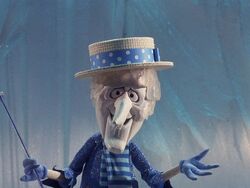
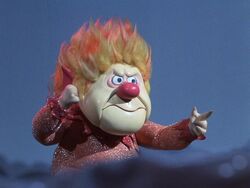
Somewhere in between, there was "The Year Without a Santa Claus," a syrupy tale of Jingle and Jangle, two elves who set out to save Christmas when Santa gets the sniffles. (Why Santa gets sick on Christmas so often is an unexplored mystery.) You actually forget that part, though, once the Miser Brothers show up. These two narcissistic avatars of nature steal the show like Samuel L. Jackson dreams he could.

In the mythopoetics of Christmas Special Land, Heat Miser and Snow Miser lord over the realms of Snow and Heat. Twin children of Mother Nature, they couldn't have been more different, except for their theme song, which was eerily similar, and spectacularly AWESOME! Listen:


It's a beautiful tune, isn't it? A rollicking good-time number, with straw hats and chorus lines clearly influenced by Bob Fosse. And I don't think it's a stretch to consider Michael Jackson watching Snow Miser's spin-move showmanship and filing it away for future use.** In the years following their introduction, the Miser Brothers have inspired literally thousands of stoners, slackers, and blog posts. It was only natural that they would appear in sequels.

In the 00's, someone did a live action special remake starring Michael McKean (from Spinal Tap) and Harvey Fierstein, which turns the two part song into a duet complete with bikini-clad minions, slingshots and crossbows. It starts off as a total train wreck, then kind of grows on you, and then goes back to train wreck... here, see what I mean:


I understand their intention here, uniting both versions into one complete number - it always seemed sort of a time-filler and union-cost-cutting move to use the same song twice - but the execution seems spotty. Why are the two heat misers' domains separated by such a thin chasm? In what realm of physics can this exist? By taking the metaphorical division of heat and cold and placing them in such proximity, the dialectic of hot and cold turns into an in-house squabble between pouty brothers, rather than an epic, meta-conflict between points of view that the original suggested.

On the other hand, I do love Harvey Fierstein's Louisiana gutter accent, and the gusto with which he's determined to sell this turd as fertilizer. The icicle up the butt at the end also seems the work of a good sport. But McKean seems to be phoning it in here, like his agent had come to him with either this or a Lenny and the Squigtones reunion tour, and he chose poorly.

But, you know, it makes me wonder where Mr. Temperate is in all this? Mr. Heat, Mr. Snow, and no one in that sweet spot in between, where we live most of our lives. That boring zone of mud and flowers and sweet spring rain. The Temperate Miser. It's always the middle child that gets forgotten. Maybe it's the lost Miser Sister, Lady Temperate. She should have her own song:

I'm Lady Brown Christmas
I'm sorta 'meh'
I'm 'Bring a light jacket,'
I'm 'Watch out for that mud!'

Friends call me Temperate Miser
Whatever I touch
gets soon enough to room temp-utch-(ure)
I'm not that much!

I never want to know a day that's outside a particular range
From fifty to seventy, say! Hey, let's wear sensible shoes!

I'm not that much!

(spoken): Yeah, thanks a lot mom, my brothers got all the attention and why? Because they're all Hot and Cold and people think I'm just a law of thermodynamics or entropy well fuck you mom it's more than that, not that you care... (fades away, mumbling)

Well, you know, it's an idea.

Merry Christmas! And hey, Santa - take some vitamins this year. No more colds!

Addendum: For completeness sake, there's also a 2008 version of the song, from The Miser Brother's Christmas, which despite its techincal advances adds absolutely nothing to the conversation.


* This special is actually called Frosty and Rudolph's Christmas in July

** The question of whether the Miser Brothers influenced the Jackson 5 or vice versa I will leave for the comments section to determine.

Tuesday, January 8, 2013

Billy Lynn's Long Halftime Walk: A Tournament of Books Review

Manhood, Football, the Media, and Cheerleaders

Billy Lynn's Long Halftime Walk, by Ben Fountain

Being one in a probably never-to-be-completed series on the Morning News Tournament of Books, scheduled to start in March

A squad of American soldiers deployed in Iraq find themselves national heroes, circa 2004. They were the victors of a brief, glorious firefight on the streets of Iraq that FoxNewsed them all to superstardom at a time when the national psyche could use a lift. So they return home on a 'victory tour' that includes adoring crowds, an over-promising agent offering a movie deal, and a semi-secret re-deployment to Iraq. Over the course of a single Thanksgiving Day, this novel unfolds in and around the confines of one of America's great secular cathedrals - old Texas stadium, during a football game between the Cowboys and the Bears.

From that brief run-down you can probably figure out that this book is a perfect storm of male jock culture,  military life, and a satire of American war-frenzy disguised as patriotism. It's a long, crazy trip with a dozen balls in the air, and Ben Fountain masterfully guides us through the whole thing. I'm kind of speechless at his accomplishment, really.


Last June, when I read this book, it easily held the coveted spot of Grebmar's Book of the Year for about two weeks. At that point I'd read some underwhelming things, and this one came across as heartfelt, richly imagined and executed, and amazing all at the same time. It's still in my top two or three, of course. But:


By the next week, a few flaws began to tarnish the award: 1) The cheerleader, Faison, is a typical male-genre fantasy woman, under-developed in character, existing mainly, to validate Billy's manhood and to offer herself as sexual salvation. 2) the owner of the Cowboys, a strange alternate of the real-life owner, is smarmily one-dimensional, as are, come to think of it, any characters not named Billy Lynn. 3) The end is actually quite good, though a single weird random act of cinematic wtf violence seemed completely unnecessary.

As I said, this was one of my favorite books of the year. Now, in the Tournament of Books, it faces a single elimination against two other Middle-East War on Terror books (neither of which I've read), and just from eyeballing, Billy Lynn faces an uphill battle to move on.

Saturday, December 29, 2012

Tournament of Books 2013: The quick and dirty rundown

The Morning News recently announced the final list for their annual Tournament of Books, the only award where the judging is transparent and competition is nearly literal. This year, eighteen books will be entered into a playoff-style bracket, and each matchup will be judged by a celebrity reviewer whose only mission is to determine which book should advance to the next round. In the most general sense, that means which book is better, but in the Tournament of Books, as in most competitions, better does not necessarily mean advancement.

You can check out the entire list with summaries and links on my Goodreads page here. I'll be reposting reviews of books I've read here in the days approaching the tournament, and as soon as the brackets are announced I will make my semi-annual Uninformed Predictions. Although this year I've read a remarkable five books in the field, more than double last year's total.

Okay, let's take a thumbnail look at the shortlist: Books with stars (*) are ones I've read.

Gone Girl by Gillian Flynn *
A brilliant thriller, well written but a bit shaggy, with an end I found to be a bit tidy and disappointing.

The Fault in Our Stars by John Green *
Two precocious cancer teens team up to fight the injustice and horror show that is Cancer.

Arcadia by Lauren Groff *
A minor disappointment. Hippies who grow up and try to stay hippies during the end of the civilized world.

HHhH by Laurent Binet 
Something to do with Nazis, World War II, and an assassination attempt.

The Round House by Louise Erdrich 
None of my attempts to read Erdrich have ended well.

How Should a Person Be? by Sheila Heti 
"... is a novel of many identities: an autobiography of the mind, a postmodern self-help book, and a fictionalized portrait of the..." zzzzzzz ... zzzzzz .... zzzz 

May We Be Forgiven by A.M. Homes 
A.M. Homes is creepy and disturbing, but not in a way that makes me want to read her books.

The Orphan Master’s Son by Adam Johnson 
This novel is set in Korea, where I've lived for two years, and I've only just now heard of it. My shame can only be excused by my illogical disdain for titles that use the template of "The X's [family member]." I will promptly shortlist this novel.

Ivyland by Miles Klee
Dark satiric sci-fi in a near-future dystopia? Sign me up!

Bring Up the Bodies by Hilary Mantel 
Part 2 of an epic medieval saga. On my longer list of "Books I should want to read."

The Song of Achilles by Madeline Miller
Iliad fan-fic from Patroclus's point of view. He and Achilles were lovers. Tragedy ensues. *Sigh*

Dear Life by Alice Munro 
Like seeing your elementary school teacher in the grocery store, it's always a surprise to find out Alice Munro exists outside The New Yorker and Best American Short Stories. Like, for instance, she has her own books! Amazing.

Where’d You Go Bernadette by Maria Semple
The Family Road Trip goes to Antarctica. Why not?

Beautiful Ruins by Jess Walter *
My pre-tournament favorite. Perhaps the best book I read last year.

Building Stories by Chris Ware
Graphic Novel by a media darling. I'm nodding knowingly.

The sixteenth spot will be filled by the surviovor of a Pre-Tournament Playoff Round. All of these books are about America's citizen soldiers fighting the Afghan/Iraq adventure. A shame they have to come home and face more bloodshed in the Tournament of Books, but as they say, the Rooster demands blood. They are:

Fobbit by David Abrams
War as seen from the command center well behind the fighting.

Billy Lynn’s Long Halftime Walk by Ben Fountain *
War as seen from soldiers home on leave, as heroes, at Dallas Cowboy Stadium, Thanksgiving Day. A frickin' riot. I loved this book.

The Yellow Birds by Kevin Powers
War as seen on the ground, by soldiers living and dying in combat.

Well, stay tuned for more! The tournament itself starts in March, but happy reading to those of you who enjoy it as much as I do.

Wednesday, December 26, 2012

Book Review: The Fault in our Stars, by John Green

The Fault in our Stars, by John Green: 

Moody, precocious Cancer Teens team up to fight hypocrisy, search out the meaning of the universe, converse with an utterly fallible God stand-in, and fall in love. Tragedy inevitably strikes. 

Much of this novel's success lies in its adherence to an emerging sub-cliche of cancer struggle, which is that the uber-cliche of cancer victims as stoic hero-fighters is itself an unrealistic bullshit tripe intended to solace those who don't have cancer. The feedback loop of heroic anti-heroes works pretty well, however, mainly due to the earnestness of Green's overall plot and prose, and only if your bullshit meter is properly calibrated for "Teen Fiction." 

Sure, The Fault in Our Stars is often overly clever. Sure, it's cloyingly romantic, and it's often manipulative in a way that its own heroes would cynically disdain. But none of that kept a certain middle-aged curmudgeon from tearing up a couple of times. You've been warned.

Tuesday, December 11, 2012

The new Man of Steel Trailer breakdown


A close reading of the new Man of Steel (Or, as I call it, Superman) Trailer.


Intro: Serious, somber music. Those of you hoping for a fun superhero movie, keep waiting.

:18 seconds
Some guy is floating kind of like Jesus, or Tom Hanks in Castaway.

:22
Whiny kid with agorophobia cries to mom for help. Mom enables his fear.

:25
Pencil bouquet. A blackboard. I'm getting flashbacks to college calculus. Will this movie assign me homework?

:40
Waves on rocks. Nothing says Superman more than waves on rocks.

:45
Guy looks guilty for saving a school bus from a lake. Wait, what?

More ominous black-screen transitions.

:50
Dad gives Clark a hard time for saving a school bus full of kids. Dad is not an enabler.

:59
Bearded guy with a faraway look in his eyes. Sort of a macho Bon Iver.

1:12
S stamp available at fine stamp stores everywhere.

1:19
A cape sighting on an ice flow. Music continues to be somber and joyless. I remember when superhero movies used to be fun. Like last summer.

Superman punches a mountain, flies really fast.

Dad is still preachy. Mom's advice to "Make things small" apparently meant nothing, as Superman is now in space.

1:50
Montage! Generic flames, a villain-like person. Maybe it's dad, come to teach Clark a lesson for saving that school bus full of kids. People running from explosions like every movie ever made.

Superman in handcuffs. Stop me before I save more lives!

Macho Bon Iver lifts something heavy.

2:00
Christopher Nolan's name solemnly invoked. So that's where the fun went...

2:30
Overstylized S, as if it were simple people would wonder where all the money went.

Fade to black.

No, seriously, this could be a good movie. Really, it could. It just looks a little serious. If I want serious, I'll go see Lincoln. So, I'm waiting with fingers crossed.

Friday, November 23, 2012

Notes on A Farewell to Arms


Ah, Hemingway. Papa. Big Ernie. The great patron saint of tough-guy sentimentality, godfather to every bitter drunk who put pen to paper. Used to be Hemingway was the great spine holding up all the ribs and meat of 20th century literature. That was when I was a kid, anyway. Today maybe not so much.

But he wrote novels. There's this novel here, with a real story and everything. It's set during World War I, a conflict fading now into distant memory. A Farewell to Arms finds Lt. Henry, a young and adventurous American, working as an ambulance driver on the entrenched fronts of Italy. Despite the shelling he's bored, spending his time in whorehouses or drinking with the Italian officers, mocking the local priests. Then he falls in love with nurse Barkley, the Austrians make a brutal push, and his life goes to heck.

Mind you, this was 1929, about a war that took place in 1918. Back before America became a world power, when Americans had to sneak into foreign armies to find war, back before the great Cold War and our lives of constant conflict. A Farewell to Arms introduced America to what America at war was like. And A Farewell to Arms was about stupid kids trying to become men, and the surprise and heartbreak they felt when the men they turned into was nothing like what they imagined they'd be.

But, yeah, I get it. Tough guys writing about war. Not very PC. Plus, the patriarchy, and dead babies. And the later Hemingway, the drunk bitter asshole. And now here he is on Goodreads, getting his chops busted by every kid forced to read him in junior high. Not that great, they say. Catherine is boring, a shallow bitch who just wants to please Lt. Henry, then dies. Why is this a classic? How has it endured, they wonder?

Well, Hemingway tried to tell you himself, in the most famous passage from this, one of his greatest novels: "The world breaks every one and afterward many are strong at the broken places. But those that will not break it kills." I think that's it, man, that heartbreak right there, how this is the story of one woman who was killed, and one man who was broken and forced to live.

Saturday, February 4, 2012

Novel review: Zone One, by Colson Whitehead

As someone just wrapping up his own zombie novella, I felt this one was just begging me to read it. So I did. Here you go:

Colson Whitehead's novel Zone One attempts a difficult move - writing a genre novel with 'literary' intentions. Leaving aside what 'literary' might mean, we're left with the question of whether a) the zombie plot is any good and b) what the book 'reads' like.

The good news is that the central idea of this book is outstanding- a plucky band of paramilitaries attempts to clear Manhattan for re-settlement after a zombie holocaust has brought civilization to a standstill. The central character is a non-special guy who goes by the nom de apocalypse Mark Spitz - a name that's left unexplained for about three-quarters of the book. If you're the type who can't wait three-quarters of a book to find out why the central character is named Mark Spitz, that's the first clue this book isn't for you.

Mark Spitz is, in his own words, a solid B student, who got through life on his special skill of being completely un-special, attracting minimal attention, and being very ordinary. This is his survival skill, in fact, a tongue-in-cheek attempt to explain why when the zombie hordes inevitably converge on whatever hiding space he's in, he will slip away, un-noticed. If that's the type of humor that's for you, then you'll love this book.

As these examples show, Whitehead's execution is a bit off-setting. It may be its off-settingness which leads this to be labeled a 'literary' book. There are endless digressions into family history, a cyclical plot, flashes back and forwards in time, all of which is drenched in dense, artsy prose that is often a bit more than is called for. But, in his defense, this is a novel about zombie apocalypse, a topic where you have to come big or go home.

Whitehead has definitely read Pynchon and David Foster Wallace, and his social commentary runs towards the concept that America, and by extension the after-apocalypse cabal that runs the reconstruction, is under the control of jingo-heavy spin-masters more interested in PR than in actually fixing real problems. Just like modern America, in other words. It's a nearly shopworn conceit done better by others, one that a zombie scenario neither really enhances nor expands upon, though it leads to a final scene that is as zombie-tastic as any zombie climax you can think of.

Don't get me wrong - Zone One is a fun romp, and compulsively page-turnable, though part of the page-turning spree may be due to your glossing over the repetitive digressions and nearly-the-same flashbacks of previous 'safe' houses that continually interrupt the real plot. It's a book that could easily lose a few pounds. Whitehead has a real wit and a strong power of observation not common in contemporary novels, zombie or otherwise. But overall, this is a read for slumming snoots or zombie fan-boys with aspirations of snoot-hood, and the purple prose and endless digressions can make it a slow slog for many readers.

Monday, March 14, 2011

Next: By James Hynes

I might have never heard of Next were it not for the Morning News Tournament of Books. I'm glad I read it, and grateful to the TOB for bringing it to my attention. I hope this book goes far; it deserves a bigger audience, and it should be able to generate huge discussions. Be aware, mild spoilers are included.

Next, by James Hynes, is a novel fundamentally concerned with men's issues. I say this as a warning and as praise; I can see women opening up Next and not finishing it, in the same way men pick up chick-lit and can't stand it. But for a certain kind of man - that is, for white males approaching fifty - Next is a deep, complicated meditation on the role of men in contemporary America.

It would be a stretch, but not much of one, to call the main character of Next, Kevin Quinn, a typical macho asshole. He sees women as objects, either of desire or scorn. He's over fifty but has a much younger girlfriend, who is a source of bemusement, exasperation and terror when she's not delivering great sex. She has him so spooked with talk of having a baby he's fled south on a plane from his native Michigan to the arid, alien world of Austin, Texas, for a job interview. It's also a few days after a major terror attack in Europe, so he's spooked about that as well.

Once in Austin, with six hours to kill, Kevin freaks out a little. He becomes dangerously obsessed with his seatmate from the plane, an even younger woman who reminds him of his most fulfilling sex partner ever, from twenty-five years earlier, a woman he'd taken sexual refuge with when the woman he was really in love with told him she could never love him. His meditations distract him not only from the job interview, but from current events which are about to overwhelm him.

Kevin has a problem typical to men: He's aware of his emotions, of his own shortcomings, and that his instinctive responses are often misogynistic and cruel. White liberal guilt, in short. But he has no mechanism to process his filters into consistently rational action, so when it comes time to act, he's paralyzed. He backs into every big decision. It's like Hemingway through a modern mirror, but where Hemingway's characters were able process their sensitivity into masculine hyper-activity, Kevin Quinn founders, emasculated by female empowerment and societal expectations, becoming resentful and unable to make decisions.

There's a lot of micro-detail in this novel: it takes place over eight hours, and every moment of Kevin's life and its middle-class bourgeois consumerism, is examined in minute detail, to the extent that you wonder why you should keep reading. Please do. Because the end may look like an action movie, with explosions and opportunities for heroism, but it's not, really. It's about redemption. Or, rather, the mechanisms of redemption - to ask whether Quinn is redeemed or delusional at the end is perhaps the central question I'm left with when this novel ended. In that, it echoes Flannery O'Connor's A Good Man is Hard to Find, and to paraphrase the Misfit's final words: Quinn would have been a better man if there were someone there to shoot him every minute.

I'm sure other readers had other reactions; I'd love to hear them.

Tuesday, February 22, 2011

Our Twisted Hero: A review


The World Wide Web, vast as it is, does not provide a lot of information (in English anyway) about Yi Munyol. One understands quickly from various sources that his father defected to North Korea during the civil war, leaving his family behind. This seminal event is held up as a principal reason Yi became a novelist with a political bent. And Our Twisted Hero, which was the first of his books to be translated into English, is an insightful allegory into autocratic rule, and the complicity of the individual.

Our Twisted Hero is set in a Korean elementary school, which will no doubt bring up comparisons to Lord of the Flies, in that the boys of the class are under minimal parental supervision (In Our Twisted Hero's case, a poor teacher), and so are free create their own moral universe. Han Pyong'tae has just transferred in to a rural school from Seoul, where he was one of the most gifted students. He finds, however, that this new rural school has a different order than in Seoul. Here, the class is run by the monitor, Om Sokdae, a boy a few years older than the rest of the class.

Om Sokdae rules the class with a system of tacit menace, and forces the other students to pay tribute to him under the threat of physical beatings and social ostracism. Han tries to disrupt the social order, but is driven to exile; eventually, like the hero of Koestler's Darkness at Noon, or Winston Smith of Orwell's 1984, he is broken, and accepts his new place in the totalitarian order he finds himself. Although, unlike those novels, the story does not end there. Sokdae is eventually loses power over the classroom, though the effects of his rule haunt Han for many years and imbue him with a dark cynicism as South Korea grows into an industrial, western-style economy where people like Om Sokdae are able to flourish.

The parallels to Korean politics and social order are insightful and frightening. South Korea, I have since learned, was led by a series of strongman presidents from the end of the civil war (1950) until as recently as 1987, the year this book was published. So the student's complicity in Om Sokdae's rule are parallel not only to the North's brutality, but to the system many contemporary South Koreans grew up under. In fact, Yi's insights on authority, self-determination, and the vigilance necessary to sustain a free society - and its implications on the role of violence in maintaining order - are relevant everywhere.

Friday, February 11, 2011

Kapitan Ri: a review

A review of the a short story Kapitan Ri, by Chon Kwangyong (1962)

As anyone who studies Korean history for the shortest amount of time finds out, the division of Korea is but one tragedy in a line of unbroken hardships dating to the end of the 19th century, when a declining kingdom was forced into a pseudo-vassalage with the Chinese empire. In 1910, Korea was annexed by Japan; in WWII occupied by the Russians, and afterwards fell to civil war and American influence, and the division that now stands to this day.

Thus, for fifty years or more Koreans lived with little sense of national sovereignty. Children were raised to speak Japanese, and professionals gave preference to Japanese officials who controlled their life. How did they live and survive? It's a complicated answer. Now, I'm not an expert by any means of Korean literature (or history). But there is probably no short story which dramatizes the first fifty years of the 20th century Korean condition better than Kapitan Ri, by Chon Kwangyong.

The title character is Yi Inguk, M.D., a surgeon who has made a comfortable living working in the Japanese clinics. He gives preference to people who can pay, which means throwing out dissidents and poor who resist Japanese rule. On admission, 'His examination of a new patient began with an inquiry over his ability to pay...' followed by questions about the disease.

In these early pages, Yi Inguk is an unsympathetic, even satirical character, a privileged doctor driven by money and not ashamed of his conciliation, a profiteer of the Japanese occupation. Later, he angers Korean dissidents when he turns one of their leaders from his clinic, and it is not until the end of the second world war, with his being held prisoner by Russians, that we gain a measure of sympathy for Yi Inguk.

But Yi Inguk is a doctor, and when this comes to the attention of his Russian captors his skills are suddenly useful to the new regime yet again. He is pulled from prison and put to use in the clinic, and eventually allowed to resume his privileged life. He even regains his most important possession, a pocketwatch given to him by the Japanese as a sign of their appreciation.

It is hard not to be sympathetic to Yi Inguk. He is not a political creature, but one who merely wants to survive (and thrive). Perhaps he is a product of the forces which shaped modern Korea, and of a culture which still respects authority and a firmly defined social order. After World War II, when Yi Inguk finds himself with an opportunity to leave the country for America, he is not hesitant to use his conciliatory skills to ingratiate himself with the new authority. As he'd learned Japanese, and then Russian, he learns to speak English. He thinks to himself, "Revolutions my come and the nation change hands, but the way out has never been blocked for Yi Inguk."

Like all great stories, there is an inherent ambiguity to the situation: Is Yi Inguk to be admired for his survival skills, or condemned for betraying the notion of Korean sovereignty? Is he a stand-in for the national character of Korea, or a straw-man for a class of citizens not to be found any more? Further reading is necessary.

Kapitan Ri can be found in the collection Land of Exile: Contemporary Korean Fiction.

Tuesday, February 1, 2011

Review: The Imperfectionists, Tom Rachman

When you find out Tom Rachman's novel The Imperfectionists is set mostly in Rome, you may think to yourself: Ah, Rome! The fountains! The statues! The history and adventure of a foreign country! The intrigue of living and working there, amongst the purebred romantics!

Then you start reading, and you find out: you're stuck with Americans. American Journalists, at that. Bitter, past-their-prime Americans entrenched in their own self-absorbed bitterness, toiling at a newspaper in its final death-throes. Americans who retain their American-ness so tightly that when they leave the building they say “I'm going to Italy for a minute. Need anything?” You might want to despair, but hold on: This book is pretty darn good. Heck, I almost never enjoy books as much as I enjoyed this one.

Perhaps it's because Americanism, it turns out, is a state of mind, unbounded by our continental shelves. The Americans who populate this collection of intertwinded stories are churlish, childish, short-sighted, bitter, often alchoholic, and fallible in uniquely American ways. Many are so wrapped up in their work and failures they fail to notice: They're living in Rome!

Or Paris, as is Lloyd Burko, longtime French correspondent of the unnamed paper. His is the first story of the collection, and a good introduction to Rachman's ideas and obsessions. He's seventy, with a much younger (fourth) wife, and he's on the downslope of a long, infamous life of unchecked impulses. He's lost his sex drive, but his wife hasn't; she spends most nights with the guy across the hall. His newspaper is out of money, and he's out of contacts, so he taps his son to feed him some dish on the goings on at the local embassy. Trouble is...

Well, things are often not as they appear in Rachman's world. Perceptions dash up against reality in surprising ways over and over again. (For journalists, these people are pretty dense.) But that's fair enough: the paper itself has no real reason for existence except the inscrutable whim of its millionaire American founder. (The story of the newspaper is told in brief italicized passages between the stories, the saga of the Ott family as it passes the newpaper down from generation to generation.) Uncertainty is the sand these people's lives are built on.

The characters are the reason to race through this book, and each chapter delivers a fresh voice, often of people so flawed that in the hands of a lesser writer the book would sink into despair. In a great feat of interior monologe, Rachman tells the story of Ruby Zaga, a bitter, middle-aged alchoholic who hates everyone and everything, as she holes up in a hotel room on new year's eve, pretending to be an American Tourist. She expects to be fired (for good reason) come Monday, and her interior voice is a constant stream of put-downs and insults, punctuated with her own muttered comments in quotes: "She locks her drawer and rakes a shivering hand through her hair, as if to dislodge spiders. 'Such pricks.' It'll feel good when she fucking quits. 'Cannot wait.'" But of course, she doesn't want to quit; the paper is all she has.

The tension between desire and reality is strong throughout all these stories. Winston Cheung, for instance, is a hapless kid who thinks he wants to be a foreign correspondent. He heads out to Cairo, where he stands around waiting for news to happen: “Every day in Cairo, news events take place. But where? At what time?” Then, a seasoned reporter comes to town and sweeps Winston up in a hilarious storm of self-absorption and danger, and Winston has to rethink his goals.

Or consider obituary writer Arthur Gopal, son of legendary writer R.P. Gopal, whose ambition ran out years ago and doesn't care about much any more. His greatest career goal is a job that “pays him to make Nutella sandwiches and cheat at Monopoly with [his daughter] Pickle.” Unfortunately, fate has another future in store for Mr. Gopal. Or Hardy Benjamin, business reporter, lonely and losing hope, who begins af affair with a shiftless Irishman who she meets when both their apartments are burglarized in the same 24 hours. Or the reader who insists on reading every word of every issue, even if it means falling behind, so that the news she is actually reading is years behind the events taking place just outside her door...

Suffice it to say that this book is filled with people in over their heads, and rogue losers on the outskirts of the romantic Europe you're used to reading about. There are affairs, or course, and bad judgement, death, unrequited love and tragedy. But there's such an effusive good-naturedness, and a sure, steady hand to guide you, you'll just be happy you've read this book. 

Tuesday, January 18, 2011

Await your Reply: A review

I like this interview with novelist Dan Chaon, found on The Believer. I like the part where he talks about his tiny little grotto in the attic where he writes, the "filthy hermit's apartment stuffed with stacks of newspapers and petrified sandwiches." I also like the part where he equates the writer's life with that of a drunk, where you "go on an all-night bender and then waking up and thinking, "You know, I think I'll do that again.""

I got to that interview because I recently read Chaon (pronouncing like Shawn)'s latest novel, "Await your Reply," last week. It's a suspense novel told in three braided parts by three young adults held in the thrall of shadowy mentors. There are allusions to Frankenstein, to Hitchcock, to Stephen King. The main plot is driven by identity theft and internet scams, and the question of how these people are connected. After a slow start, it picks up steam and becomes an enthralling, haunting page turner.

It's spooky as hell, really, even if not everything works right. I had a hard time believing Lucy, a recent high school graduate who has run off with her history teacher, was really in love. It wasn't just the lack of any sexual energy between the two characters, but her overall passivity that turned me off. Likewise, Miles, whose twin brother descended into the depths of schizophrenia, was equally passive, and though intensely obsessed with finding his twin Hayden, was clumsy and incompetent as an investigator. Ryan, the third central character, goes to Las Vegas to execute a con that nets him thousands of dollars, and spends the night in his hotel room, too spooked to order up a forty dollar hooker. Something about that just seemed wrong to me, but maybe that says more about me and my dirty mind than it does about Chaon's skills as a novelist.

Also, the details of the identity scams that backbone the master plots were laughably sketchy. The central scam itself that gives the novel its title is based on a variant of the Nigerian scam that any fifth grader can see through, which seriously undermines what little reality underlies the plot. Chaon freely admits he didn't to a lot of research on the authenticity of internet scams, preferring to concentrate on the psychology of theft, so I'll cut him some slack for that, because as I said earlier, it's a pretty good page turner.

There are also some beautiful scenes in this novel: one fantastic set piece takes two characters to the bottom of an evaporated lake bed in Nebraska, where a once drowned village has been returned to the air in a state of phantasmagoric transformation. Miles's journey to a remote island in the Canadian arctic is equally harrowing. And the conception of individuals as real-life representations of on-line personas whose real life is in the Internet, is a disturbing allegory of modern isolationism, and I awoke one night from disturbing dreams whose seeds, I'm sure, were planted in this novel. Chaon himself, tucked away in his writer's attic, clicking his way around the internet while researching this book, probably got a little spooked during the course of his writing, and who could blame him?

Lots of people called this their favorite book of 2009, including Michael Schaub of Bookslut. It was also a finalist for the National Book Awards of that year. While Schaub may have been a bit overexuberant, it's easy to see his point. Who are we, and what is a person? Chaon asks these sorts of questions all the time. True, it's kind of a naive question, really, when you think about it. But in the age of the Internet, when we as persons are defined more as agents in a transactional monetary system, rather than as biological beings with connections to other real people, it's one worth asking. "Await your Reply" may or may not work for you, but it's important because it finds answers that are disturbing but true, which is what we should expect of any art.

Sunday, January 2, 2011

Mini-Anthology of the best stories I read last year

It's almost the end of list-making season, so I thought I'd join the fun. Here's a top-of-my-head mini-anthology of great stories I read last year, from any source, new or classic or whatever.

Defender of the Faith, by Philip Roth (O. Henry Prize Stories, 1960 (second place!))
Early in his career, Roth was just as powerful as he is today. This story about an army Sergeant torn between his Jewish identity and his duties in the army is complicated, powerful, and moving. Roth deserves every award in America, and every reader.

Closely Held, by Allegra Goodman (BASS 2008)

Goodman just writes damn well. Like Roth, she touches on normal experiences and expands them into the cosmosphere. This one's about a computer entrepreneur whose company is getting huge, but he just wants to write code. He's also growing distant from his over-worked wife, and almost begins an affair with the only female coder in his office. A beautiful story.

The Fake Nazi, by Aimee Bender (Ploughshares, nos 2 & 3)
Aimee Bender surprised me here. As a modern American, she takes on Nazi guilt, metaphysical ponderings, sibling rivalry, 21st century politics, and delivers a weird, satisfying experience.

Sublime Child, by Gina Berrault (O. Henry Prize Stories, 1960)
This story is a about a married New Yorker whose mistress dies. Her daughter is 19, and out of sympathy at first, he continues to visit her. Then he gets other motives for visiting her. Inappropriate things occur. Choices are made. Ominous and creepy, a demonstration that mature themes don't involve explicit sex.

Cowboys, by Susan Steinberg (American Short Fiction Issue 47)
A poetic short piece about a woman mourning the death of her father and meditating on her own ensuing promiscuity. Stories that wallow in the depths of bad behavior are filled with tripwires that explode in bad fiction, but Steinberg's voice was original and her emotions honest, and it didn't pad or get self-pitying.

Nawabdin Electrician, by Daniyal Mueenuddin (In Other Rooms, Other Wonders)
A great story with an honest voice about corruption, poverty, and justice in Pakistan. These are themes some Americans are afraid to touch without distance and irony, but this story about an aging electrician who gains the respect of his community, and its slow build to a conclusion around the theft of his motorcycle is powerful and elegant, a story that could never take place in America but nevertheless touches universal themes.


Lorelei, by Jerome Charyn (Atlantic Fiction edition)
When I think back on this summer, and the time I spent with this story, I think about homecomings and disappointments, and meditations on how people become the people they are, and how they stay that way despite their own best interests. I loved this story about a con man who returns home to find his first love still tucked into her childhood life, and the reunion that turns to horror, that is also the story of a decaying way of life, a Southern Gothic in a New Jersey hi-rise.

The Kid, Salvatore Scibona (New Yorker summer fiction edition)
Just go read this one. It'll break your heart.

Nobody Said Anything, by Raymond Carver (Will you Please be Quiet, Please)
Carver did so much with so little that a lot of people think he's over-rated. People dismiss him as Bukowski without the sadism, or Hemingway without the macho posturing, or as precursor to minimalist navel-gazing. But he's not that - he's Carver, king of the eighties, and still worth reading. Anyway, this story is about an adolescent kid who plays sick to stay home from school, then goes down to the local stream to fish. When he gets home with his trophy, his parents are fighting, and in the closing moments, as his joy breaks against his parent's heartache, you'll understand what the fuss around Carver was about. Or, if you feel nothing, you'll know you have a heart of stone, and there is no hope for your soul.

The Silence, TC Boyle (Atlantic Fiction Edition)
Wacky, deep satire. Funny, ambitious, crazy. How Boyle tosses off things like this is a mystery. It's about pilgrims in the desert, being stupid. Snark, but snark I like. So I'm complicated. Sue me.

2011 will no doubt take more turns than I can expect. Hang on!

Saturday, December 18, 2010

Two Christmas Stories from 1960: a review

Prize Stories, 1960: The O. Henry Awards.

It had been a while since I'd read a good story set at Christmas. Maybe I just don't pick up the magazines at the right time, or maybe today's secular left-wing cabal of publishers and editors don't recognize Christmas as a proper theme for a story anymore. Okay, it's probably not that, but I don't know for sure. On the other hand, back in1960, when the editors of the O. Henry Prize stories collection were doing their thing, two stories set around Christmas managed to get into their book, which I recently picked up at a used bookstore in Dinkytown. Now, they're not really about Christmas. One is set on Christmas day, the other uses a Christmas gift as a plot stimulus. But still - tis the season, and all.

The first story, the one that won First Prize in the O. Henry stories that year, is called The Ledge, and it was written by Lawrence Sargent Hall. You needn't worry if you've never heard of him before, I hadn't either. He was a respected scholar at Bowdoin University as well as a writer of fiction, and this story has been in over 30 anthologies.

In this story, a fisherman takes his son and his son's friend out duck hunting on Christmas day. It's off the coast of Maine, where low tide leaves large ledges in otherwise open sea, and as they are gathering ducks they rest a skiff on one of the ledges. The skiff drifts away, leaving them stranded on the ledge. Soon, the tide starts coming in, and the with rising water they eventually drown. (Sorry to be a spoiler.)

As I said, it's not really about Christmas, unless you want to read religion into it. But it's a good story, told in a sparse Yankee voice filled with foreboding doom. The people are nameless, their characters a rough sketch of noble peasantry, the tale an unremitting parable of man v. nature, pride falling before circumstance and generosity under adversity, the Christmas angle all but forgotten by the end.

The other story was written by Elizabeth Enright, who I also knew nothing about.  She was, despite my ignorance, a popular author of children's books, and a well-respected adult writer whose work regularly appeared in all the journals of the day. Her story A Gift of Light displays all these talents, along with a gift for social conscience and wit.

In the story, a woman buys a Christmas gift for her housekeeper's son: A flashlight that lights red, green, and white. The boy loves the gift and goes out for a walk with it. It draws the attention of thieves, who recruit the boy for his small size to crawl over a fence and let them in to an affluent apartment complex, where they rob the place and then are chased by police. The boy returns home. He's lost the flashlight but gained ten dollars, his share of the job. This is a wonderful, light story with much deeper implications of class and race, and a microcosm of any large American city in that magic, Eisenhower era, just before America awakened and found itself in the mess of the 60's.

I know, I know - it's a cop-out cliche to say that the late 50's were a simpler time, but for the most part the stories in this collection draw their effectiveness from being earnest and uncomplicated. Their style is uniformly classical: Past tense narration, omniscient knowledge, objective facts, within a moral framework both comforting and slightly claustrophobic. There's a sense that all the writers adhered to old-school concepts of their role as an author: They exist only to get the story out there, to be invisible, and not muck around with calling attention to themselves.

In 1960, Faulkner and Hemingway were alive but dormant as writers; John Cheever had been publishing for seven years, and would soon be joined by Philip Roth and John Updike to begin their long run as alpha males of American literature. To Kill a Mockingbird was one year away, as was Tropic of Cancer. And yet the O. Henry collection of 1960 is devoid of big names. Save for Philip Roth's Defender of the Faith (which you should definitely read if you care about American fiction at all), there is not a single name I recognize in this collection. So I wasn't sure what to expect when I started reading these stories, but I wasn't dissappointed at all.

Thursday, October 14, 2010

The new BASS is here! The new BASS is here!

Yes, it's autumn and the new Best American Short Stories has hit the shelves! Sporting a dark, brooding black cover for the first time in memory, BASS lept off the shelf to my eager hands. I paged through it and... I'm not in it. This is how I find out?

Okay, that's kind of a silly joke. What I really did was page through the table of contents to see if I'd read any of them already. Then I counted up which magazines had the most entries. Usually this ends up being the New Yorker. They publish over 50 stories a year, most of them acceptable, so just by numbers they end up swamping the competition. However this year they did not. Tin House, the quarterly from Portland, managed to land and astounding 4 entries, 20 percent of the collection. The Atlantic, which published only six pieces or so a year, and that in a special 'writer's ghetto' edition, managed to place three of their stories, or half their year's lot, into the best of the best. McSweeney's, bellweather of what's hip and snarky and stridently alt-moral, landed three as well. (I do not subscribe to McSweeney's, though they have in the past surprised me with some incredible, lucent, off-center, indespensible prose.) The New Yorker, slipping from their perch of tastemaker for modern fiction, only scrounged up two entries this year. The rest of the entries came from high-level college quarterlies or literary institutions: The Virginia Quarterly Review, Ploughshares, The Paris Review, etc.


In short and on first glance, this year's editor, Richard Russo, seems to have taken few risks to go outside the boundaries of mainstream literary fiction. Half the selections come from just three sources, meaning if you follow short stories with any dedication, you've seen these already. I'm sure all the Tin House stories will come back to me on starting them.

Anyway, I look forward to diving in and reporting back, gentle reader, on the foibles and endearing quirks of this latest check on the pulse of American short fiction.

Saturday, September 11, 2010

Random reviews and rambling

Mentioned herein:
Girl with the Dragon Tattoo, Stieg Larsson
The End, Salvatore Scibona
The Fake Nazi, Aimee Bender
Ploughshares Magazine

It's no secret I've been reading a lot of short stories lately. Partly, my attention span has been stunted by work, and soon, school. More on that later. It also seems like every novel I've picked up lately has been awful. I tried Girl with the Dragon Tattoo, but the prose was horrid, and the pacing terrible, and the political posturing shallow. I'd heard you have to get through the first 50 pages for it to pick up, so I remained patient. After 75 pages people kept telling me you had to get through the first 100. I read to page 110, and when someone told me it didn't really pick up till page 150, I gave up. I didn't want to get to the end before deciding I was enjoying the book.

I've since picked up Salvatore Scibona's The End, based on the promise of his short story in a recent New Yorker. And it's okay, but it's a very fractured thing. It follows the lives of Italian immigrants in Ohio in the first half of the 20th century. The first section was about a baker who one day oversleeps, then drives out to New York to bring back his estranged family. He gets sidetracked to Niagra Falls, where he has an ice cream, then the narrative leaves him there while it switches to a different woman in the same neighborhood with no immediately obvious connection to the baker. The book flap copy indicates they're all linked by some terrible secret, but 100 pages in, I still have no idea what it is. I like the book and hope to finish it, but like Girl with the Dragon Tattoo, I'm not sure I'm invested in the story, or even why I should be. There's no urgency for me to discover what happens next.

So I've turned back to the short story, where the investment is smaller and the pay-offs just as satisfying. I picked up the recent issue of Ploughshares, the literary journal of Emerson University. For those of you who don't know, much of American short fiction is published by University sponsored small journals. It's a measure of American literature's health, really, that artsitic fiction has become subsided by the education industry, in effect they're publishing the art and writers they'll be writing critical essays on in the future. Sounds like narcissistic inbreeding, but there you have it.

In this issue of Ploughshares is Aimee Bender's new story, The Fake Nazi. I cringed at the title, but dove in, and was pleasantly surprised. It's about a man in Germany who walks into the police station and confesses to holocaust atrocities. But he's wrong - he's too young, for one thing. They find his apartment filled with Nazi movies and novels and newspaper articles - he's apparently been living with guilt for crimes he never committed. Eventually, his life and death haunt a secretary in the legal system where he had periodically tried to surrender himself. She investigates his life, and discovers a past lover, then his brother, and all the secrets to who he was, and how he fit in society.

Here's the kicker: She does all in 13 pages. It's a testament to the power of the short story, and of Aimee Bender's skill, that she can do this, while Stieg Larson had to fumble through 100 pages before I gave up on him, and Salvatore Scibona hid all the meat of his book in dark, intellectual wrappings and Faulknerian posturing. I think it's sad that writers these days are ashamed of just telling stories. You know, something happened, so I did this, and then this happened. It's hard, Lord don't I know it. It's easier to be a stylist than a storyteller, maybe, or it's too hard to resist the urge to be clever and intellectual.

So anyway. I'm not sure where I'm going with this blog, or my reading, and may take a break. Then again I may not. Other things are coming at me, or rather, I'm going towards other things. So, keep checking in and stay in touch.